
Home / Client Resources / Fabric Guide
Reference guide
The IPS Fabric Guide For Bags, Packs & Outdoor Gear
ConceptForge stages this guide supports
ConceptForge stages: Design, Prototype, Source
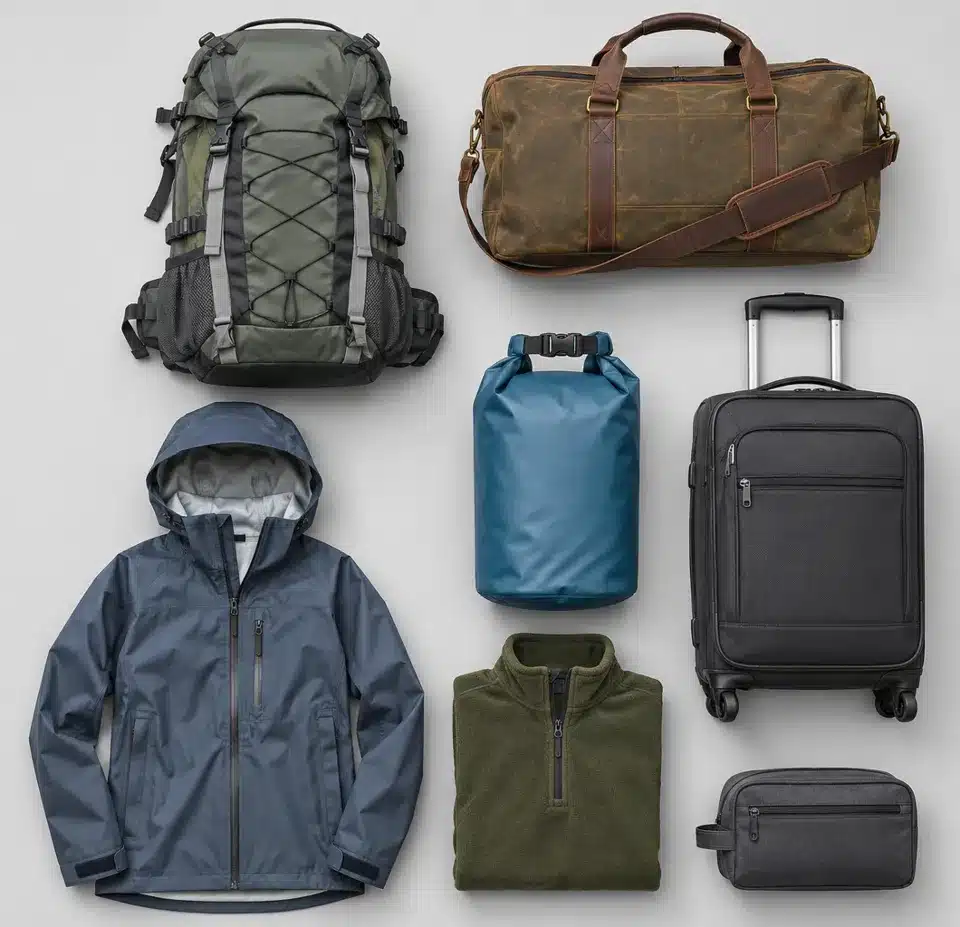
Every fabric is a stack of decisions
Here is one spec line a factory can quote from without asking a question.
- 500DYarn sizeDenier: yarn weight in grams per 9,000 m. Higher means thicker yarn, not always stronger fabric.
- Nylon 6,6, air-texturedFiber and yarnThe polymer and how the yarn is made. Air-texturing gives a cotton-like, abrasion-resistant face.
- Plain weave, 54 × 40ConstructionThe weave pattern and yarns per inch (warp × weft). Tighter is stronger and more wind-resistant.
- 7.0 oz/yd²WeightFabric weight per square yard, about 237 gsm. Confirm whether it includes the coating.
- 1.5 oz PU, C0 DWRFinishA polyurethane back coating for water resistance plus a fluorine-free (PFAS-free) water-repellent face.
- 58/60″ usableWidthCuttable roll width. It sets how many panels fit across the roll, and so cost.
The same fabric, written in a tech pack
Example bill of materials (BOM) line. Add the mill and article number once the fabric is approved.
- Placement
- Body front, back and base panels
- Material
- 500D nylon 6,6, air-textured (Cordura® or approved equivalent)
- Construction
- Plain weave, 54 × 40 per inch
- Weight
- 7.0 oz/yd² (237 gsm) finished, incl. coating, ± 5%
- Finish
- 1.5 oz/yd² PU back coat; C0 (PFAS-free) DWR
- Width
- 58/60″ usable
- Color
- Black, solution-dyed; lab dip to Pantone® 19-0303 TCX
- Supplier / article
- [Mill name] / [Article no.]
- Testing
- ASTM D5034, ASTM D2261, AATCC 22 (90+), PFAS-free declaration
Jump to a section
Fibers: what the fabric is made of
Fiber sets the ceiling on strength, abrasion, UV life, comfort and cost. Most bag and outdoor fabrics are nylon or polyester.
| Fiber | Strengths | Weaknesses | Typical use |
|---|---|---|---|
| Nylon 6,6 | Highest abrasion and tear strength of common fibers; soft hand | Absorbs some water; weaker UV resistance; costs more | Cordura®, ballistic, ripstop, webbing |
| Nylon 6 | Cheaper, dyes deeply | Slightly lower strength and melt point | Mid-market bags, linings |
| Polyester | Holds shape wet; good UV; low cost; easy to recycle | Lower abrasion and tear than nylon at the same denier | Value bags, oxford, fleece, activewear |
| Cotton | Natural hand, takes wax and dye, heritage look | Heavy; absorbs water; mildews; shrinks | Canvas, duck, waxed canvas, totes |
| Polypropylene | Very light, cheap, sheds water | Poor UV and heat resistance | Budget webbing, nonwoven totes |
| UHMWPE (Dyneema®) | Strongest fiber per weight; waterproof | Expensive; hard to dye and bond | Ultralight packs |
| Aramid (Kevlar®) | Heat, cut and flame resistance | Poor UV; expensive | Protective panels |
| Wool and merino | Warm when wet, odor resistant | Cost; lower abrasion | Base layers, socks |
| Spandex (elastane) | Stretch and recovery | Degrades with heat and chlorine | Blended 2–20% into knits |
Rule of thumb for bags: nylon for abrasion and premium products, polyester for value and UV, cotton for heritage looks.
Weaves and knits: how yarn becomes cloth
Construction decides stretch, tear behavior, drape and how a fabric cuts and sews.

Common weaves

| Weave | How it looks | Why use it |
|---|---|---|
| Plain | Over one, under one | Stable and crisp; base for taffeta, canvas, packcloth |
| Oxford | Paired yarns weave as one | 210D–900D bag fabrics; good value and printability |
| Ripstop | Heavier yarns woven in a grid every few millimeters | Stops tears spreading; light packs and outerwear |
| Twill | Diagonal rib | Softer drape, hides dirt, resists abrasion |
| Basket (ballistic) | Two or more yarns woven as one, both ways | 1050D–1680D ballistic nylon for luggage |
| Duck / canvas | Tight, heavy plain weave of plied yarns | Totes, tool bags, waxed canvas |
Grain matters. Cut panels along the warp (lengthwise) for stability and mark grain direction on every pattern piece. The bias, at 45°, is the stretchiest direction.
How fabric is spec’d
A complete spec is one line a factory can quote from without asking questions. These are the terms that line is made of.
| Term | What it means | Watch for |
|---|---|---|
| Denier (D) | Yarn weight: grams per 9,000 m | Higher denier is thicker yarn, not automatically stronger fabric |
| Dtex / tex | Grams per 10,000 m / 1,000 m | Common in Asia and Europe; dtex is about denier × 1.11 |
| Construction | Warp yarns × weft yarns per inch, e.g. 54 × 40 | Tighter constructions are stronger and more wind- and water-resistant |
| Weight | oz/yd² (US) or g/m² (gsm); 1 oz/yd² ≈ 34 gsm | Ask whether the figure includes the coating |
| Usable width | Cuttable width, without selvedges | Drives how many panels fit across the roll, and so cost |
| Duck number | #1 heaviest to #12 lightest cotton canvas | #10 ≈ 15 oz, #8 ≈ 18 oz, #12 ≈ 11.5 oz |
| Solution-dyed | Color added to the polymer before spinning | Far better UV and colorfastness; higher minimums |
| Color reference | Pantone® TCX/TPG or Lab values | Approve lab dips on the actual fabric, not paper |
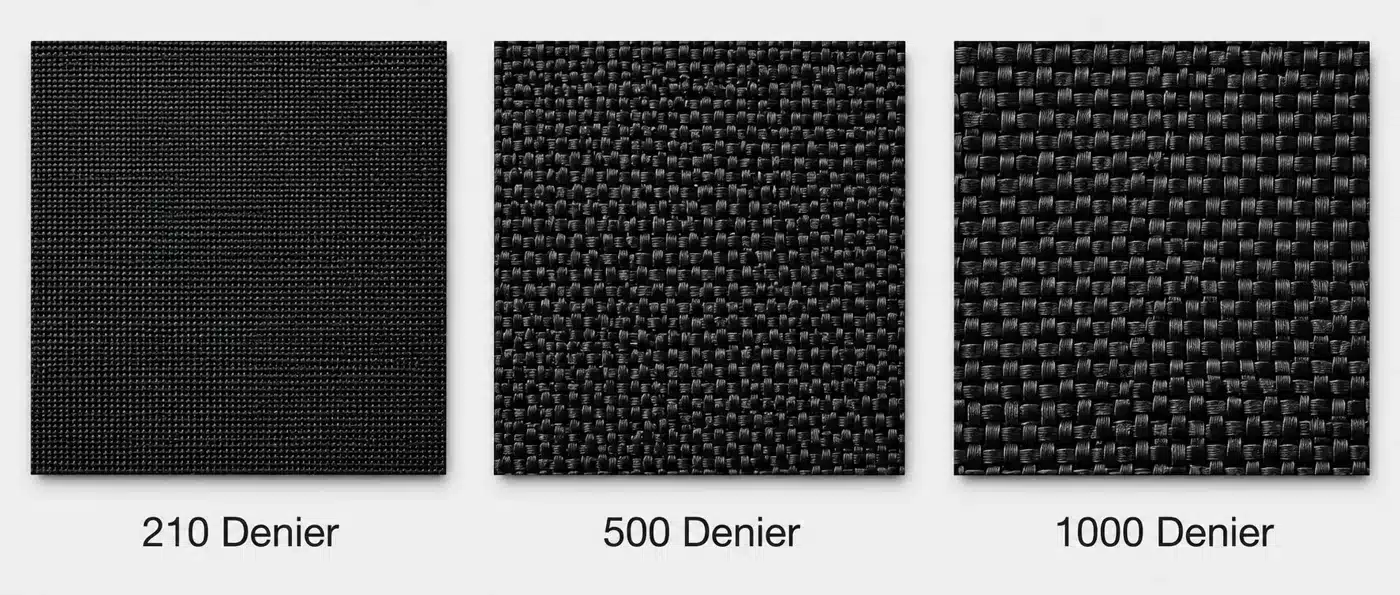
Weight bands
| Band | oz/yd² | gsm | Examples |
|---|---|---|---|
| Ultralight | under 2 | under 70 | 20–40D ripstop, silicone-coated nylon |
| Light | 2–4 | 70–135 | 70D taffeta linings, 210D nylon |
| Medium | 4–8 | 135–270 | 420D packcloth, 500D Cordura®, 7 oz canvas |
| Heavy | 8–14 | 270–475 | 1000D Cordura®, 1050D ballistic, 12–15 oz duck |
| Very heavy | over 14 | over 475 | #8 duck, coated tarpaulin |
Denier is not quality. A 420D high-tenacity nylon can outperform a generic 600D polyester. Compare tear, tensile and abrasion data, not just the denier number.
Coatings, waterproofing and PFAS
Finishing turns raw cloth into a performance fabric. It often drives cost, lead time and compliance more than the base fabric.
| Coating | What it does | Pros | Cons |
|---|---|---|---|
| PU (polyurethane) | Water resistance and body on the back | Cheap, flexible, standard | Breaks down (hydrolysis) in heat and humidity over 3–7 years |
| TPU | Waterproof coating or film | Durable; heat- and RF-weldable | Costs more; stiffer |
| PVC / vinyl | Heavy waterproof coating | Very cheap, very waterproof | Heavy; phthalate and Prop 65 risk |
| Silicone | Coats ultralight nylon both sides | Strong, UV stable | Hard to seam-tape, print or bond |

| Measure | Unit | Typical targets |
|---|---|---|
| Hydrostatic head (waterproofness) | mm water column | 1,500 water resistant; 5,000–10,000 waterproof shell; 20,000+ high end |
| MVTR (breathability) | g/m²/24h | 5,000 basic; 15,000–20,000 good; 25,000+ high |
| RET (breathability, lower is better) | m²Pa/W | Under 6 very breathable; 6–13 good; over 20 poor |
PFAS rules now apply to textiles. Traditional water-repellent (DWR) finishes use PFAS chemistry. California and New York bans on intentionally added PFAS in textiles and apparel took effect January 1, 2025, with severe-wet-weather outdoor apparel exempt until 2028. More states are phasing in rules.
Specify C0 (fluorine-free) DWR on every new product and collect a PFAS-free declaration from every mill.
Waterproof fabric is not a waterproof product: seams, zippers and needle holes leak unless they are taped, welded or covered.
Testing: the numbers to ask for
A fabric claim without a named test method is marketing. Ask for a third-party report on the exact fabric you are buying.
| Property | Test method | What it tells you |
|---|---|---|
| Tensile strength | ASTM D5034 | Force to break the fabric |
| Tear strength | ASTM D2261, D1424 | Whether a small cut becomes a rip |
| Abrasion | ASTM D3884 (Taber), D4966 (Martindale) | How long the surface survives scuffing |
| Seam strength | ASTM D1683 | Whether the seam fails before the fabric |
| Waterproofness | AATCC 127 / ISO 811 | Hydrostatic head in mm |
| Water repellency | AATCC 22 | DWR performance, rated 0–100 |
| Colorfastness to light | AATCC 16 | Fading in sun |
| Colorfastness to rubbing | AATCC 8 | Dye transferring onto clothing |
| Flammability | 16 CFR 1610 | Required for apparel sold in the US |
| Restricted substances | CPSIA, Prop 65, PFAS screening | Legal to sell |
Minimum package for bags: tensile, tear, abrasion, seam strength, colorfastness and restricted substances. Add waterproofness and spray rating if you make a water claim.
Bag and pack shell fabrics
Shell fabrics take the abrasion, UV and load, so they set a product’s durability and price point.

| Fabric | Construction | Best for | Pros | Cons |
|---|---|---|---|---|
| Cordura® 500D / 1000D | Air-textured nylon 6,6, PU coat, DWR | Premium packs, duffels, tactical | Benchmark abrasion; cotton-like hand | Cost; licensed mills only |
| Ballistic nylon 1050D / 1680D | High-tenacity nylon, basket weave | Luggage, tool bags, belts | Extremely tough, premium look | Heavy, stiff, frays |
| Polyester oxford 600D / 900D | Basket-look weave, PU or PVC back | Promo, school, value bags | Cheap, prints well | Lower abrasion; PVC compliance risk |
| Nylon packcloth 420D | Filament plain weave, PU | Pack bodies, pouches | Light, strong, smooth | Slippery, shows wear |
| Ripstop 70D–420D | Plain weave with reinforcing grid | Light packs, stuff sacks | High tear strength for weight | Thin grades puncture |
| X-Pac®-type laminate | Face + polyester X-ply grid + film | Structured, waterproof packs | Waterproof, light, holds shape | Crinkly; can delaminate |
| Dyneema® composite | UHMWPE fibers between films | Ultralight packs | Strongest per gram | Very expensive; low abrasion |
| Recycled packcloth | rPET plain weave, PU | Eco lines | Recycled-content story | Polyester limits |
| TPU-coated nylon | Woven base + TPU | Dry bags, waterproof packs | Weldable, PVC-free | Higher cost |
| PVC tarpaulin | Polyester scrim + vinyl | Dry bags, coolers | Fully waterproof, cheap | Heavy; compliance and eco concerns |
Brand names are licensed. Cordura®, X-Pac®, Dyneema®, GORE-TEX® and Polartec® can be marketed only when you buy from approved mills and follow brand rules. Generic equivalents cost less but cannot use the name.
Linings
Linings hide seams, protect contents and carry the brand inside. For stain-resistant, wipe-clean accessory bags, choose a coated or laminated lining.

| Lining | Best for | Pros | Cons |
|---|---|---|---|
| Polyester taffeta 190T–290T | Value bag and jacket linings | Cheap, smooth, light | Snags; feels cheap at low counts |
| Coated taffeta | Wipe-clean bag interiors | Spills bead and wipe off | PU coating ages |
| Coated 210D nylon packcloth | Pack and pouch liners | Durable, wipe-clean | Rustles |
| Brushed tricot / microfleece | Sunglass, phone, electronics pockets | Scratch-free | Holds lint |
| TPU-laminated knit | Toiletry and cosmetic bags, wet pockets | Waterproof, wipe clean, weldable | Higher cost |
| PEVA / EVA film | Wet bags, lunch bags | Waterproof, cheap, PVC-free | Tears; can look cheap |
| Food-grade TPU or PEVA | Lunch bags, cooler liners | Meets food-contact rules | Needs FDA or LFGB documents |
| Cotton twill or poplin | Heritage canvas bags | Matches natural shells | Stains and absorbs |
Stain resistance comes from a non-absorbent surface, a PFAS-free repellent finish, or a color that hides marks. Specify the test (AATCC 130 stain release, AATCC 118 oil repellency) rather than just “stain resistant.”
Apparel and outdoor fabrics
These are the fabrics you will see at performance sourcing shows. Apparel is judged on comfort as much as durability.

| Fabric | Use | Pros | Cons |
|---|---|---|---|
| Poly/spandex jersey | Tees, tops, golf polos | Stretch, wicking, sublimation-friendly | Holds odor, pills |
| Nylon/spandex knit | Leggings, compression, swim | Soft, strong, high recovery | Cost; less UV stable |
| Merino blends | Base layers, socks | Odor resistant, warm when wet | Cost, durability |
| Hardshell (2L, 2.5L, 3L) | Rain and ski shells | Waterproof, windproof | Cost; seams must be taped |
| Softshell | Active jackets, golf layers | Stretch, breathable, wind resistant | Not fully waterproof |
| Fleece | Mid layers, pouch linings | Warm, light, dries fast | Sheds microfibers, pills |
| 4-way stretch woven | Hiking and golf pants | Durable with stretch | Can bag out |
| Down insulation | Spec’d by fill power (550–900+) | Best warmth for weight | Fails when wet |
| Synthetic insulation | Spec’d by g/m² (60, 100, 133) | Warm when wet, easy to sew | Heavier; loses loft |
Cotton and waxed canvas
Cotton canvas sells the heritage and lifestyle story. It is spec’d by weight or duck number, plus finish.

| Fabric | Use | Pros | Cons |
|---|---|---|---|
| Numbered duck (#8–#12) | Tool bags, totes, aprons | Very durable, classic | Heavy, stiff, absorbs water |
| Army duck | Bags, casual goods | Smooth; takes dye and wax | Less body than numbered duck |
| Waxed canvas | Heritage bags, dopp kits, jackets | Water resistant; rich patina | Wax transfers; needs re-waxing |
| Dry-finish wax | Premium bags with less tack | Less transfer, cleaner hand | Less water resistance |
| Coated cotton (PU/TPU back) | Water-resistant lifestyle bags | Canvas look, better weather | Loses breathability |
| Denim | Lifestyle bags, aprons | Iconic look | Indigo rubs onto contents |
| Hemp and organic cotton | Eco lines | Sustainability story | Supply, certification paperwork |

Designing in waxed canvas: pair it with a liner that won’t show wax transfer, test transfer onto white fabric, avoid seam tape, and put care instructions (cold, spot clean, re-wax) on the label.
Leather, synthetic leather and vinyl
Used for trims, bases, handles, patches and full bodies. Spec by thickness, backing, surface and abrasion rating.

| Material | Use | Pros | Cons |
|---|---|---|---|
| Full-grain leather | Premium trims, handles | Ages well | Cost, variation, yield loss |
| Split / suede | Bases, accents | Cheaper | Less durable, stains |
| PU synthetic leather | Fashion bags, golf accessories | Consistent, many textures | Peels over time; avoid cheap grades in flex areas |
| Microfiber synthetic leather | Premium trims, gloves | Closest to real leather | Costs more than standard PU |
| PVC marine vinyl | Marine, coolers, golf carts | Very durable, cleanable | Phthalate risk; heavy |
| Clear TPU / vinyl | Stadium bags, windows | See-through | Scratches; PVC yellows |
| Cork and plant-based leathers | Eco accessories | Distinctive story | Durability varies; test carefully |
Mesh, foam and structure
These hidden materials decide how a bag stands, carries and protects. They are where factories most often substitute cheaper material.

| Material | Spec it by | Use |
|---|---|---|
| Power / stretch mesh | Fiber, weight, stretch % | Side and bottle pockets |
| 3D spacer mesh | Thickness (mm), weight | Back panels, straps, hip belts |
| PE closed-cell foam | Thickness, density | Padding, laptop sleeves, coolers |
| EVA foam | Thickness, Shore hardness | Molded panels, structured cases |
| PU open-cell foam | Thickness, density, compression set | Shoulder straps, comfort padding |
| HDPE / PP sheet | Thickness (mm) | Bag bottoms, frame sheets |
| Interfacing (fusible or sew-in) | Weight, type | Structure in wallets and accessories |
Always give foam a thickness tolerance (e.g. 6 mm ± 0.5 mm) and say whether it is laminated to fabric or loose.
Swatch gallery
Fifteen reference fabrics for bags and outdoor products. Images are illustrative renderings, not to scale; always approve real swatches.
 500D textured nylonCordura®-type shell
-
1000D textured nylonHeavy-duty shell
-
1050D ballisticLuggage, tool bags
-
600D poly oxfordValue bags
-
420D packclothPack bodies, pouches
-
Ripstop nylonLight packs
-
Laminated pack fabricX-Pac®-type
-
Waxed canvasHeritage bags
-
#10 cotton duckTotes, tool bags
-
Coated taffetaWipe-clean lining
-
TPU-coated fabricDry bags
-
3D spacer meshStraps, back panels
-
PU synthetic leatherTrims, accessories
-
Polyester fleeceMid layers, linings
-
3-layer shellWaterproof outerwear


Designing for cut and sew
Cut-and-sew is a labor business: every panel, seam and operation adds minutes, and minutes drive factory price.
- Design fewer panels. Fewer cuts, fewer seams, less waste on the roll.
- Never hang load on a single layer. Straps need a reinforcement patch, bartacks or a box-X stitch, and a path into a seam.
- Finish every raw edge. Wovens fray; call out binding, piping or overlocking.
- Specify the hidden materials. Foam, interfacing, thread size and stitches per inch.
- Match fabric to construction. Waterproof fabrics need taped or welded seams.

| Seam or stitch | Where used | Notes |
|---|---|---|
| Lockstitch (301) | Most bag construction | Typically 7–10 stitches per inch for bags |
| Bound seam | Bag interiors | Clean, durable finish; adds cost |
| Flat-felled | Unlined bags, heritage goods | No raw edges; more labor |
| Bartack | Strap ends, pocket corners | Specify length and stitch count |
| Box-X | Webbing to bag body | Classic strap reinforcement |
| Welded or taped | Waterproof products | Needs TPU or PVC; RF, hot-air or ultrasonic |

From sketch to production
- Sketch and spec
- Paper or muslin mock-up for proportions
- First prototype in real or substitute materials
- Fit and function test; revise the pattern
- Salesman sample in production materials and colors
- Pre-production sample approval: the factory’s golden sample
- Top-of-production sample from the bulk run
Working with mills and factories
A factory builds exactly what the tech pack says. Anything vague becomes the factory’s cheapest interpretation.
What a softgoods tech pack needs
- Sketch views and a revision date
- Bill of materials: supplier, article number, fiber, weight, width, color and consumption for every material
- Finished dimensions with tolerances (bags commonly ± 1/4 in)
- Construction details: seam types, stitches per inch, thread, edge finishes, reinforcements
- Hardware and trims, artwork and logo method, colorways
- Required tests, compliance documents and packaging
| Term | What to know |
|---|---|
| Stock vs custom | Stock colors ship fast with low minimums; custom color or finish triggers MOQ |
| MOQ | Custom fabric minimums are often 500–3,000 yards per color |
| Lab dip | Small dyed sample to approve color before bulk; allow 1–2 weeks |
| Lead time | Stock: days. Custom dye: 3–6 weeks. New construction or laminate: 8–12+ weeks |
| Shade band | Dye lots vary; approve a range and keep lots together per order |
| Nominated vs factory-sourced | Brand names the mill for control, or the factory picks for cost |
How fabric drives price: for most bags, materials are the largest share of factory cost. Material cost is price per yard × yards per unit (including waste), so fewer panels, standard widths and stock colors cut cost directly.
Compliance and certifications
Compliance is cheapest when it’s specified at the material stage. Fixing it after bulk production means remaking product.
| Topic | What applies | Action |
|---|---|---|
| PFAS | State bans on intentionally added PFAS in textiles | Specify C0 DWR; mill declarations; fluorine test |
| Prop 65 | California warnings for listed chemicals | Avoid PVC and lead-containing hardware; test |
| CPSIA | Children’s products 12 and under | Third-party testing, tracking labels, certificate |
| Fiber and origin labels | FTC Textile Act | Fiber %, country of origin, RN number |
| Care labels | FTC Care Rule | Care symbols per ASTM D5489 |
| Tariff classification | Customs origin and HTS rules | Confirm early; IPS handles this for clients |
| Certification | What it covers |
|---|---|
| bluesign® | Chemicals and environmental management at the mill |
| OEKO-TEX® Standard 100 | Finished textile tested for harmful substances |
| GRS / RCS | Recycled content through the supply chain |
| GOTS / OCS | Organic cotton |
| RDS / RWS | Responsible down and wool |
| LWG | Leather tannery environmental audit |
Frequently asked questions
Quick answers to the questions brand owners ask most about bag and outdoor fabrics.
What is the best fabric for backpacks and bags?
It depends on the job. Air-textured nylon 6,6 (Cordura®-type, 500D to 1000D) is the benchmark for premium packs and duffels. 1050D ballistic nylon suits luggage and tool bags, 600D polyester oxford suits value and promotional bags, X-Pac®-type laminates or TPU-coated fabrics suit waterproof, structured packs, and waxed canvas or cotton duck suit heritage styles.
What does denier mean, and is higher denier better?
Denier is yarn weight: grams per 9,000 meters of yarn. Higher denier means thicker yarn and usually more abrasion resistance, but fiber, yarn type and weave matter more than the number. A 420D high-tenacity nylon can outlast a generic 600D polyester, so compare tear, tensile and abrasion test data rather than denier alone.
What is the difference between Cordura® and ballistic nylon?
Cordura® is a brand of air-textured nylon, usually 500D or 1000D, with a matte, cotton-like feel and excellent abrasion resistance. Ballistic nylon is a smooth, high-tenacity filament nylon, usually 1050D or 1680D, in a basket weave. Ballistic is stiffer, shinier and very tough but frays at cut edges; Cordura® is more common for packs and duffels, ballistic for luggage, tool bags and belts.
Is waxed canvas waterproof?
Waxed canvas is water-resistant, not waterproof. Wax fills the gaps between cotton yarns so water beads up, but needle holes and seams still let water through, and the wax wears and needs re-waxing. For a truly waterproof bag, use a laminated or TPU-coated fabric with welded or taped seams.
What is PFAS-free (C0) DWR, and do I need it?
DWR is the durable water-repellent finish on a fabric face. Traditional DWRs used PFAS chemistry (C8 or C6); C0 means fluorine-free. California and New York bans on intentionally added PFAS in textiles and apparel took effect January 1, 2025, with severe-wet-weather outdoor apparel exempt until 2028, and more states are following. Specify C0 DWR and collect a PFAS-free declaration from every mill.
How do I specify a fabric in a tech pack?
Write one line a factory can quote from: denier and fiber, yarn type, weave and construction, weight in oz/yd² and gsm, coating and finish, usable width and color. Then add placement, supplier and article number, and the tests you require. The tech pack example at the top of this guide shows the format.
What are typical fabric minimums and lead times?
Stock fabrics can be bought by the yard and ship in days. Custom colors or finishes typically need 500 to 3,000 yards per color, with 3 to 6 weeks for custom dyeing and 8 to 12 or more weeks for a new construction or laminate. Choosing stock colors and standard widths is the fastest way to cut both minimums and lead time.
Can IPS source the fabric and manufacture my bag?
Yes. International Product Solutions develops and manufactures bags, packs and outdoor products with factories in Cambodia, Vietnam, China and Taiwan, from material selection and tech packs through sampling, testing and delivery. Request a free Product Viability Check for feasibility, recommended materials, best-fit factory and estimated landed cost.
Glossary
Show 24 common terms
| Term | Meaning |
|---|---|
| Bartack | Dense zigzag stitch reinforcing a stress point |
| Bias | 45° to the grain; the stretchiest direction of a woven |
| C0 / C6 / C8 | Fluorine-free / short-chain / long-chain water-repellent chemistry |
| Calendering | Pressing fabric between hot rollers for a flat, sealed surface |
| Consumption | Yards of material used per finished unit |
| Crocking | Color rubbing off onto another surface |
| Delamination | Layers of a laminate separating |
| Denier | Yarn weight in grams per 9,000 m |
| DWR | Durable water repellent face finish |
| FOB | Factory price including delivery to the port of loading |
| Greige | Unfinished fabric straight off the loom |
| Hand | How a fabric feels |
| Hydrolysis | Breakdown of PU coatings by heat and humidity |
| Hydrostatic head | Waterproofness in mm of water |
| Lab dip | Color sample approved before bulk dyeing |
| Marker | Layout of pattern pieces on fabric for cutting |
| MOQ | Minimum order quantity |
| Notch | Pattern mark for aligning pieces |
| PP sample | Pre-production sample approved before bulk |
| Selvedge | Finished edge of a woven roll |
| Solution-dyed | Color added to the polymer before spinning |
| SPI | Stitches per inch |
| Usable width | Fabric width you can cut, excluding selvedges |
| Warp / weft | Lengthwise / crosswise yarns |
Cordura®, X-Pac®, Dyneema®, GORE-TEX®, Polartec®, Kevlar®, Pantone®, OEKO-TEX® and bluesign® are trademarks of their respective owners. IPS is not affiliated with or endorsed by these brands; names are used only to identify materials.
Got a product idea? Let’s make sure it can be made.
Tell us what you want to make. We reply within 1 business day with a free viability check: feasibility, recommended materials, best-fit factory and estimated landed cost.